Missing Meals & Map the Meal Gap

Missing Meals in Arizona

People oftentimes ask for an explanation on how to quantify the amount of food needed to feed everyone who struggles with hunger in Arizona, or how much money or other resources are necessary to tackle the hunger issue once and for all.  New research by AAFB and St. Mary's Food Bank Alliance, along with Feeding America Map the Meal gap data below, helps to answer those questions by painting a picture of who is struggling with hunger by county, and what resources they are relying on to get by.  This groundbreaking data shows nearly 17% of meals were missing from the diets of working poor Arizonans in 2009, the most current data available. These missing meals are what would allow every individual in Arizona to eat three meals per day but are instead being skipped and not eaten because those affected cannot afford them. 

This equates to 375,687,507 actual meals missing for the “working poor,” a group comprised of those living at or below 185% of the Federal Poverty Level (FPL), which is $40,800 for a family of four.

A staggering 1 in 3 Arizonans, or 2.02 million individuals, out of an estimated 6.36 million population, is considered working poor.

By Arizona County, Greenlee County (26.9%), Yavapai County (23.4%) and Pima County (20.7%) have the highest missing meal percentage for the working poor. Maricopa County’s working poor are estimated to miss 18.9% of their meals.  View PDFs of selected Arizona Counties (more coming soon) to see more detailed information on where the meals for their working poor population come from:

Arizona Statewide
Coconino County
Greenlee County
Maricopa County
Mohave County
Pima County
Pinal County
Yavapai County
Yuma County

Ultimatley, this Missing Meals data will allow food banks and AAFB to better identify and target areas experiencing high levels of hunger, poverty and food insecurity.  It also helps paint a picture of who the "working poor" are in Arizona and what their struggle with hunger and poverty looks like.


Feeding America Map the Meal Gap

Feeding America's Map the Meal Gap project seeks to learn more about the face of hunger at the local community level.  By better understanding the population in need, communities can better identify strategies for reaching the people who most need food assistance.  Traditionally, Feeding America, AAFB and food banks throughout the country have used state and national level USDA food insecurity data to estimate the need (e.g. “50 million Americans are at risk of hunger”), but better and more local information is needed.

Until now, the number of people falling below the federal poverty threshold has been the indicator most typically used for identifying the need for food at the local level because it is one of the few indicators available at the county level.  However, national food insecurity data reveal that about 45% of those struggling with hunger actually have incomes above the Federal Poverty Level ($22,350 for a family of four in 2011), and 53% of poor households do not suffer from food insecurity.  Thus, measuring need based on poverty alone does not accurately capture everyone who is struggling with hunger.

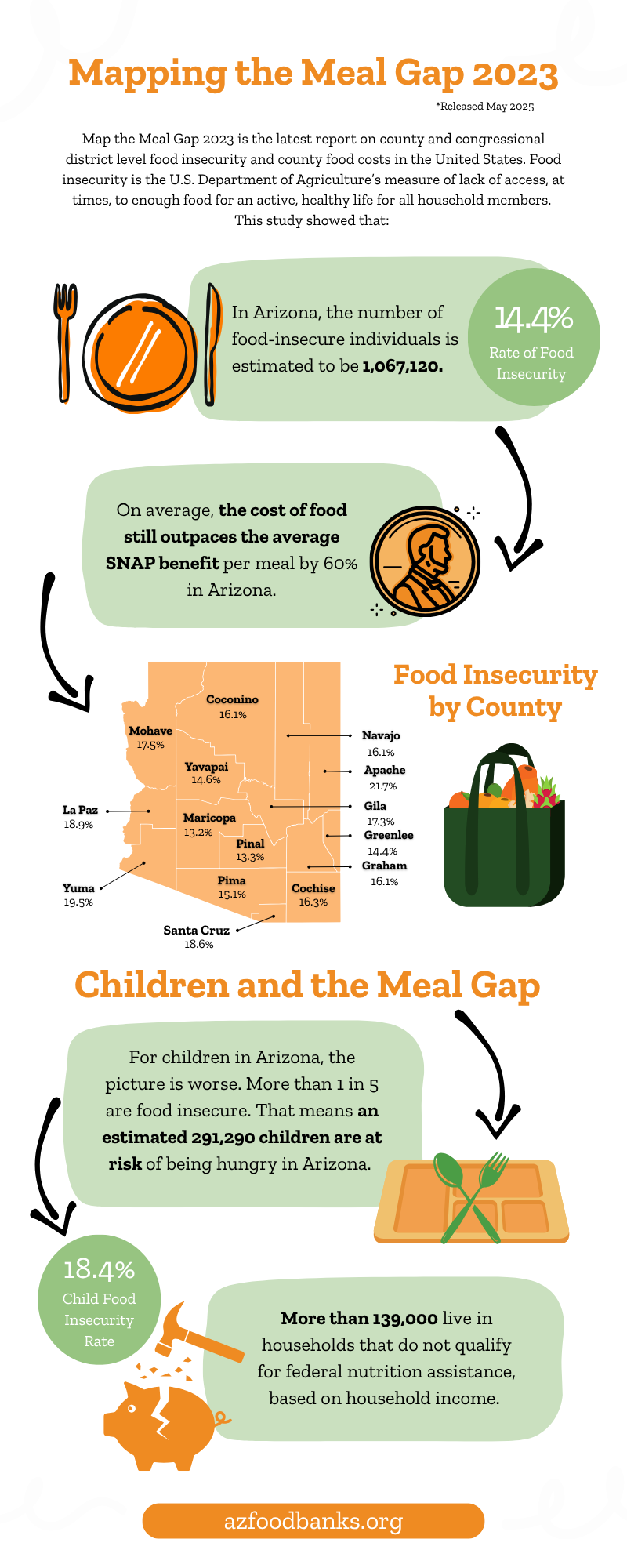
Focusing on Arizona in the Map the Meal Gap study on food insecurity and missing meals, Feeding America estimates 15.3%—or 183,874,629 meals—are missing across the board in Arizona for those suffering from food insecurity, or the inability to provide enough food to feed the household. In Arizona, more than 1.1 million people are food insecure, affecting 1 in 6 individuals.

Map the Meal Gap breaks down food insecurity rates by county and Congressional District, providing an estimate of how much money it would take to make everyone food secure. Apache County (28.5%), Yuma County (27.9%) and Navajo County (24.5%) have the highest rates of food insecurity in Arizona. By comparison, Maricopa County is 16.2% and Pima County is 17.0% food insecure. By Congressional District, District 4 (24.7%), District 7 (21.3%) and District 1 (19.2%) have the highest food insecurity rates, coinciding with food hardship data by Congressional District released earlier this month by the Food Research and Action Center (FRAC). That report determined 2010 food hardship levels by analyzing Gallup survey data on whether households had enough money to buy needed food.

 View the Feeding America Interactive Map the Meal Gap Map 
 
 Feeding America Map the Meal Gap Executive Summary 
 
 Feeding America Map the Meal Gap Full Report
(PDF)


What is "Missing Meals," How is it Calculated and Who is Affected?

Generally speaking, the Feeding America Map the Meal Gap data looks at the bottom sixth of Arizona’s population, while the AAFB data expands that to the bottom third to provide a broader perspective on how pervasive hunger is today. Collectively, both data sets complement each other in providing a complete picture of just how many Arizona households are struggling with hunger. These households can be found in communities large and small throughout all fifteen Arizona counties, comprised of individuals from every age and ethnic group. In short, they are the households most impacted by the recession, unemployment, home foreclosure and lingering economic uncertainty. In addition, many of these households earn too much to qualify for SNAP (Food Stamp) benefits or other public assistance, yet struggle to afford enough food to put on the table each and every day.

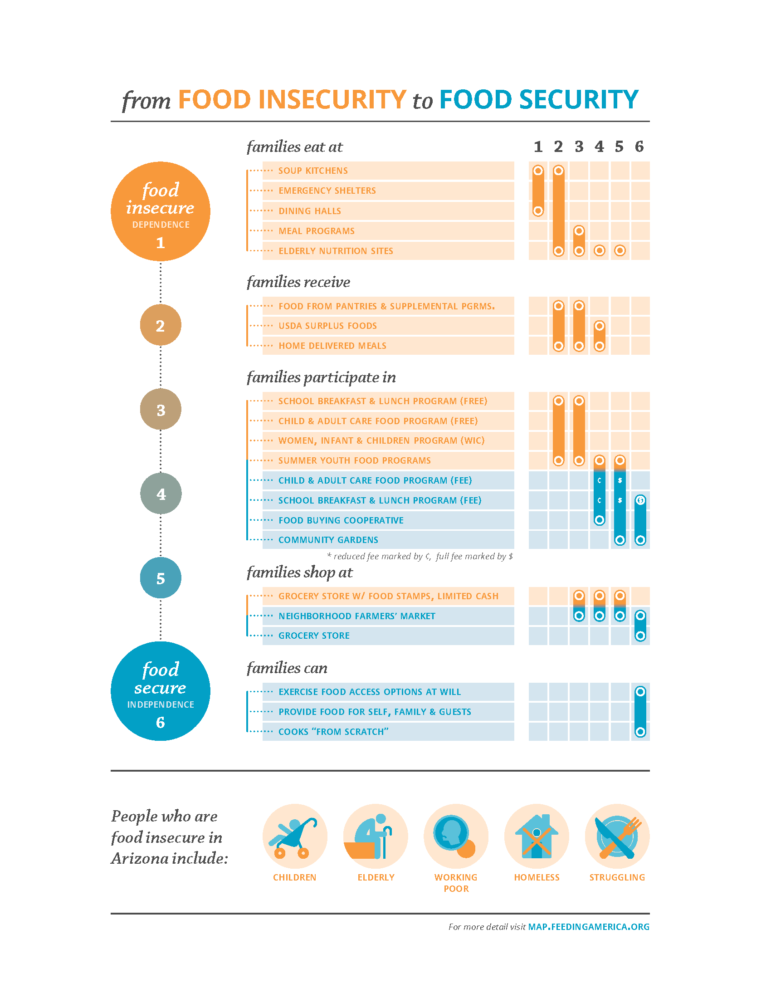
The term “missing meals” refers to meals that are not provided by oneself, public assistance such as SNAP, WIC (Women, Infants & Children) school meals and other programs, or from private sources such as food banks. It is calculated based on the assumption people eat three meals per day. In Arizona, meals consumed by the working poor population breaks down like this:


Using the 2009 Consumer Price Index average cost per meal of $2.43, which both AAFB and Feeding America’s Map the Meal Gap use, it would require an additional $446,958,770 to move every Arizona individual out of food insecurity, while it would take almost a billion dollars—$912,920,642—to eliminate the missing meal gap for the working poor population.

AAFB’s missing meals data is calculated based on U.S. Census Bureau poverty and population statistics, participation rates for various public assistance programs, pounds of food distributed by Arizona food banks, data provided by St. Mary’s Food Bank Alliance, and Consumer Price Index food price data. Feeding America’s Map the Meal Gap is based on statistics collected by the U.S. Department of Agriculture, U.S. Census Bureau, and food price data from The Nielsen Company, and conducted using well-established, transparent methods.